
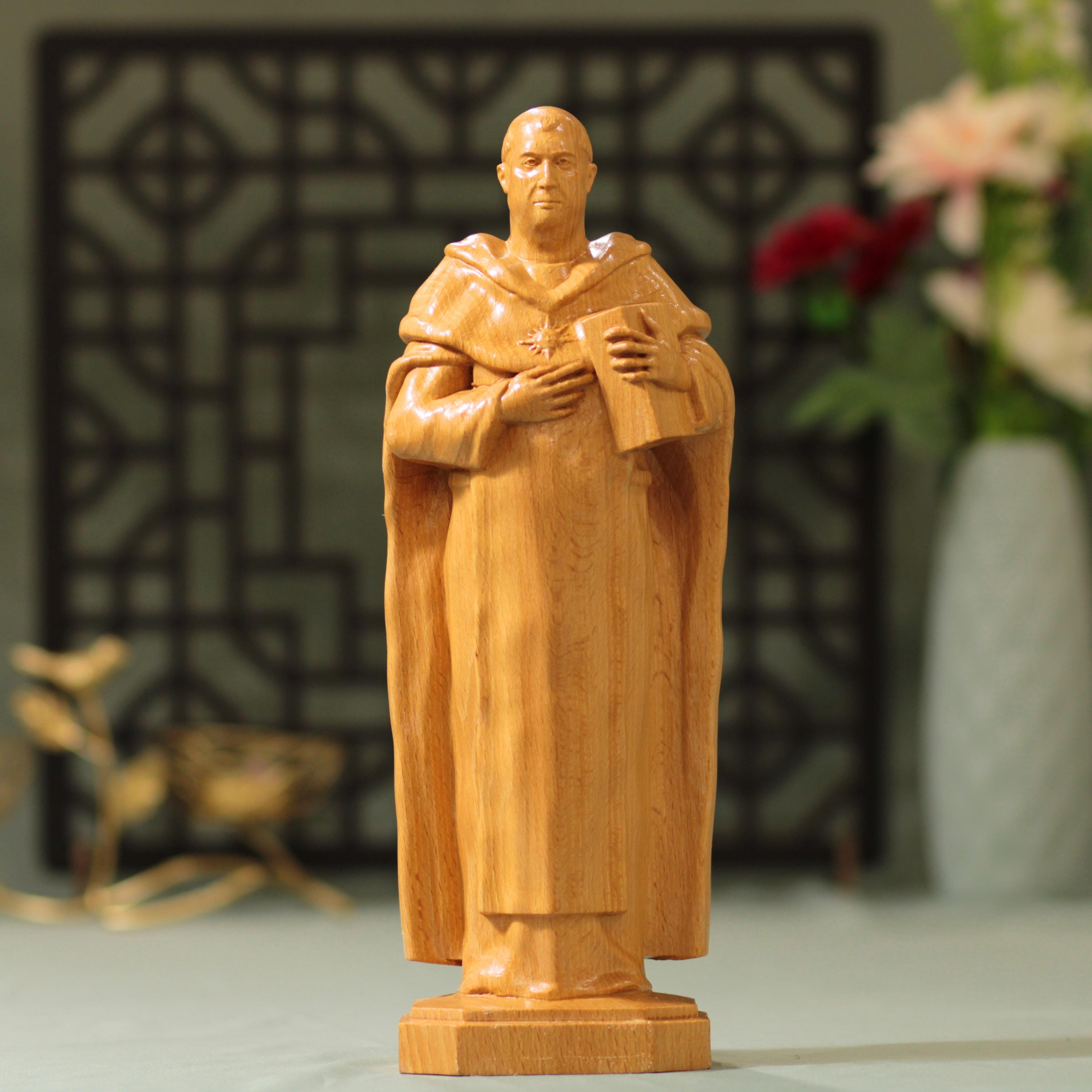
Saint Thomas Aquinas stands as one of the greatest minds in the history of the Catholic Church and, indeed, of Western civilization. Known as the “Angelic Doctor,” he was a Dominican friar, priest, theologian, philosopher, and Doctor of the Church whose writings continue to shape Catholic theology, moral teaching, education, and spiritual life more than seven centuries after his death. In the United States today, Saint Thomas Aquinas is deeply revered by clergy, theologians, students, educators, seminarians, and lay Catholics who seek a faith that is both intellectually rigorous and deeply rooted in love of God.
For American Catholics, Saint Thomas Aquinas represents something profoundly attractive: the conviction that faith and reason are not enemies but friends, that the human intellect is a gift from God, and that careful thinking can lead us closer to truth, goodness, and holiness. His life, teaching, and enduring influence make him a saint especially relevant to modern believers navigating questions of science, ethics, culture, and faith.
This article offers a comprehensive exploration of Saint Thomas Aquinas: his life, spiritual journey, major works, theological vision, moral philosophy, influence on the Church, and ongoing relevance for Catholics today—especially within the context of Catholic life and education in the United States.
Early Life and Family Background
Thomas Aquinas was born around the year 1225 at Roccasecca, a castle near Aquino in the Kingdom of Sicily, in what is now Italy. He came from a noble family connected to both the Holy Roman Empire and the Kingdom of Naples. His parents, Landulf of Aquino and Theodora, envisioned a prestigious ecclesiastical career for their son, possibly as an abbot or bishop, positions that carried both spiritual authority and political influence.
At the age of five, Thomas was sent to the Benedictine monastery of Monte Cassino, where his uncle served as abbot. There, he received his early education in prayer, Scripture, Latin, and the classical liberal arts. The Benedictine monks hoped Thomas might one day become abbot of Monte Cassino, a role that would bring honor and power to his family.However, God had a different plan.
Encounter with the Dominicans
As political conflicts forced Thomas to leave Monte Cassino, he continued his studies at the University of Naples. There, he encountered something new and unsettling to his family: the Order of Preachers, commonly known as the Dominicans. Unlike older monastic orders, the Dominicans were mendicant friars who lived in poverty, preached publicly, and engaged directly with universities and urban life.
Thomas was drawn to their way of life—simple, apostolic, intellectually serious, and completely oriented toward the preaching of truth. Against the strong objections of his family, he secretly joined the Dominican Order around 1244.
His family reacted with outrage. His brothers kidnapped him and held him under house arrest for nearly a year, attempting to persuade him to abandon the Dominicans. They even resorted to scandalous tactics to tempt him away from religious life. Thomas resisted calmly and steadfastly, reportedly driving away temptation with a burning brand and dedicating his purity to God.
Eventually, his family relented, and Thomas was released to continue his vocation.
Formation and Education
Thomas studied under some of the greatest intellectual figures of his time, most notably Saint Albert the Great, a Dominican scholar and scientist. Albert quickly recognized Thomas’s extraordinary intellectual gifts, even though the young friar was quiet and reserved—so much so that his classmates nicknamed him “the Dumb Ox.”
Saint Albert famously responded, “You call him a dumb ox, but I tell you that his bellowing will one day resound throughout the world.”
Thomas studied in Paris and Cologne, immersing himself in theology, philosophy, Scripture, and the newly translated works of Aristotle. At the time, Aristotle’s writings were controversial, and many feared they would undermine Christian faith. Thomas, however, saw in Aristotle a powerful philosophical framework that could be purified and elevated by Christian revelation.
The Harmony of Faith and Reason
One of Saint Thomas Aquinas’s most enduring contributions is his teaching on the harmony of faith and reason. He firmly believed that truth cannot contradict truth. Since God is the author of both natural reason and divine revelation, properly understood philosophy and authentic theology must ultimately agree.
For Thomas:
• Reason can discover many truths about the world and about God, such as God’s existence. • Revelation teaches truths that surpass human reason, such as the Trinity and the Incarnation. • Faith perfects reason; it does not destroy it.This vision remains foundational for Catholic intellectual life in the United States today, especially in Catholic universities, seminaries, and high schools where students are encouraged to think critically while remaining faithful to Church teaching.
Major Works of Saint Thomas Aquinas
The Summa Theologiae
The most famous work of Saint Thomas Aquinas is the Summa Theologiae. Written as a teaching tool for students, it is a vast synthesis of Catholic theology, addressing God, creation, human nature, morality, Christ, and the sacraments.
The Summa follows a clear and methodical structure:
• Questions are posed clearly. • Objections are presented honestly. • A theological response is given. • Each objection is answered carefully.This approach reflects Thomas’s respect for intellectual honesty and dialogue—qualities deeply appreciated in American academic culture.The Summa remains a cornerstone of Catholic theological education and is frequently cited in the Catechism of the Catholic Church.
The Summa Contra Gentiles
Another major work, the Summa Contra Gentiles, was written to explain and defend the Christian faith in dialogue with non-Christians, particularly Jews and Muslims. It emphasizes rational arguments accessible to all people, regardless of religious background.This work continues to inspire Catholics engaged in evangelization, interfaith dialogue, and apologetics in the United States.
Biblical Commentaries and Hymns
Saint Thomas Aquinas also wrote extensive biblical commentaries and composed some of the Church’s most beautiful Eucharistic hymns, including:• Pange Lingua • Tantum Ergo • Adoro Te DevoteThese hymns are still sung in American parishes today, especially during Eucharistic Adoration and the Feast of Corpus Christi.
Thomas Aquinas and the Eucharist
Saint Thomas Aquinas had a profound love for the Eucharist. His theology of the Real Presence—expressed through the doctrine of transubstantiation—helped the Church articulate clearly what Catholics believe happens at Mass: the bread and wine truly become the Body and Blood of Christ.In a culture like the United States, where belief in the Real Presence has weakened among some Catholics, the Eucharistic theology of Saint Thomas Aquinas remains urgently relevant. His clear, reverent explanations continue to support Eucharistic renewal efforts across American dioceses.
Moral Theology and Virtue
Saint Thomas Aquinas developed a moral theology centered on virtue, happiness, and the ultimate goal of human life: union with God. He taught that true happiness is not found in pleasure, power, or wealth, but in knowing and loving God.Key elements of his moral teaching include:
• Natural law: moral truths accessible to human reason. • Cardinal virtues: prudence, justice, fortitude, temperance. • Theological virtues: faith, hope, charity. • Grace: God’s life within us, healing and elevating human nature.
This framework deeply influences Catholic moral teaching in the United States, especially in discussions of bioethics, social justice, human dignity, and family life.
Saint Thomas Aquinas as Teacher and Priest
Despite his intellectual brilliance, Thomas Aquinas lived humbly. He celebrated Mass with deep devotion and often wept during the Eucharistic Prayer. Toward the end of his life, after a mystical experience during Mass, he declared that all he had written seemed like straw compared to what God had revealed to him.
He died in 1274 while traveling to the Council of Lyons, obedient to the Church even in frail health.
Canonization and Doctor of the Church
Saint Thomas Aquinas was canonized in 1323 and later declared a Doctor of the Church. Pope Leo XIII strongly promoted Thomistic philosophy in the modern era, and many American seminaries and universities continue to draw inspiration from his thought.
Patron of Students and Educators
• Students • Universities • Schools • Philosophers • TheologiansIn the United States, his feast day on January 28 is widely celebrated in Catholic schools, colleges, and seminaries.
Relevance for American Catholics Today
In a society marked by rapid change, moral confusion, and intellectual polarization, Saint Thomas Aquinas offers a steady and hopeful witness:
• Faith can be intelligent. • Reason can be holy. • Truth can be loved.
He encourages American Catholics to engage culture confidently, to think deeply, and to live virtuously.
Saint Thomas Aquinas remains a towering figure not because he offered easy answers, but because he trusted that all truth ultimately leads to God. His life and work continue to guide the Church in the United States as it seeks to proclaim the Gospel with clarity, charity, and intellectual integrity.For Catholics striving to unite prayer and study, devotion and reason, tradition and mission, Saint Thomas Aquinas remains a faithful companion and powerful intercessor.
Saint Thomas Aquinas, pray for us.